Sell Theranyx
Innovative Solutions for Receptor Activity Regulation
Theranyx is a French biotech company founded in 2010 on a unique technology platform that has proved instrumental in the development of novel therapeutic solutions for the treatment of cancer.
The mission of Theranyx is to discover, develop and commercialize new antibody fragments, mainly targeting cancers, with an improved efficiency and a lower toxicity than the compounds currently available to patients.
As a proof of concept, Theranyx discovered 12 fully functional antibodies fragments, demonstrating an innovative pharmaceutical profile against two ion channels and two peptides receptors, for which patent applications have been submitted.
As a fundamental aspect of computer-aided drug design, protein structure has become a standard tool of modern drug discovery process. Nevertheless membrane receptor structure resolution remains a challenging research project.
Our membrane receptor purification expertise has been built on more than a decade of technology development. We are today in the position to overcome all the major bottlenecks.
Read more
VHHs also known as Therabodies are variable fragments of camelid single domain antibodies (sdAb). VHHs are obtained from PBMC of immunized llama or camel and offer superior properties than classical antibodies in many aspects
G protein-coupled receptors (GPCRs) and ion channels belong to the two largest protein families and mediate key physiological functions. As the industry focuses strongly on drugs targeting GPCRs up to 40% of marketed pharmaceuticals fall under this category. Ligands have been identified for approximately 240 GPCRs, of which half target drugs on the market (60 GPCRs) and in development (68 GPCRs). In contrast, drugs targeting ion channels represent only 1.9% of the pharmaceutical market today. Surprisingly, out of the 400 genes coding for ion channel subunits, only 15 represent targets for marketed drugs. The reason for the low rate of target application is mainly due to the difficulty in specific modulation of the activity of this class of proteins by small molecules. Most ion channel functions have not been thoroughly characterized because of limited tools for pharmacological and functional evaluation.
Our mission
We are in a position to propose an extensive collection of membrane receptors and related products and services. Our product line will not be limited to membrane preparations and stable cell lines, but also purified receptors and reconstituted vesicles, which constitute an exclusive alternative for the market today. We have demonstrated rapid discovery of functional antibody fragments using purified active receptors (patent pending). Functional antibody fragments can significantly improve the development of molecules modulating specifically the activity of ion channels and the discovery of novel regulation mechanisms. Our goal is to systematically screen for functional antibodies targeting purified receptors either using our own antibody development platform or through strategic partnerships.
Everything you need, for receptor purification
As a fundamental aspect of computer-aided drug design, the protein structure has become a standard tool of the modern drug discovery process. Nevertheless, membrane receptor structure resolution remains a challenging research project. Theranyx's original four-step approach to structure resolution enhances the chance of success, while a pay-by-results approach reduces the financial risk to clients.
Our structural studies are conducted in four steps:
Receptor expression
Receptor expression is conducted in parallel in four cell types (HEK, CHO, Sf9, and S2) and two constructs in order to identify the most suitable format for large scale purification. The objective at this step is to reach an expression level compatible with the crystallisation screening, meaning mg/l yields. This step is charged only if an expression yield in excess of a million receptors per cell is achieved. The number of receptors is estimated by western blot and by radio ligand binding when available. The functionality of the target of interest will also be assessed by additional means where suitable (e.g. gene reporter, patch clamp, calcium release…)
Receptor purification
Receptor purification starts with the screening of solubilisation conditions in detergents compatible with crystallisation conditions (with respect to size and homogeneity). The receptor monodispersity in detergent is assessed by analytical gel filtration. The receptor conformation integrity is also controlled using ligand binding assay (when available). When ligand binding properties are lost by the receptor in detergent, lipid vesicle reconstitution screening is performed to retrieve it. Large scale purification is conducted using the best solubilisation conditions to obtain mg quantities of receptor in monodisperse form. As an additional step, directed proteolysis can lead to the improvement of the monodispersity of the receptor.
Binders development
The availability of a strong affinity binder facilitates the structure resolution of membrane receptors in three ways:
1) it increases the polar surface of the receptor, thus enabling the formation of new crystal bonds while mitigating the problems of flexible loops;
2) it can stabilize the receptor in a single conformation, thus increasing the homogeneity of the sample; and
3) it can increase the solubility of the receptor, thus facilitating its purification.
Finally, the selection of binders may lead to the discovery of functional molecules that can be useful as pharmacological tools for target validation or even for therapeutic applications.
The selected binders are characterized to determine their affinity, potential functionality, induced improvement of receptor stability, solubility and monodispersity. This step is charged for only if binders with nanomolar range affinity are discovered.
X-ray structure resolution
Crystallization screenings are performed using both vapour diffusion and lipid cubic phase methods in the presence of the best selected binders or combinations of binders. The best crystal hits are optimized so that high resolution data can be collected at a synchrotron radiation facility. This step is charged for only when a high resolution structure can be obtained.
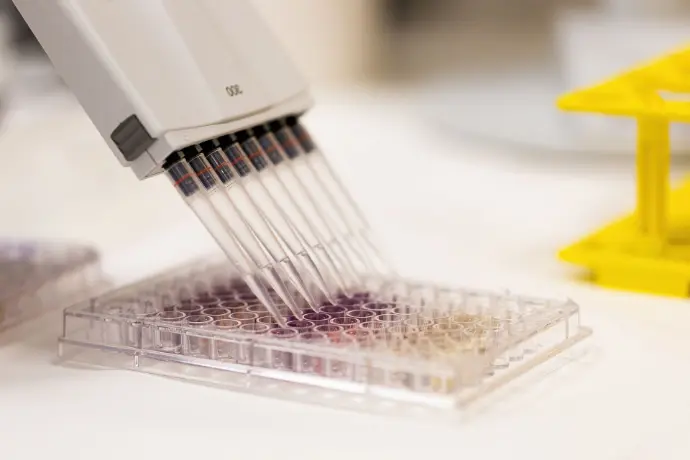

We create the perfect
tailored solution for you
Secured
Tell what's the value for the
customer for this feature.
All in one
Write what the customer would like to know,
not what you want to show.
Easy to use
A small explanation of this great
feature, in clear words.
Useful options
Beautiful snippets
Amazing pages
Outstanding images
Our mission
Provide clear and concise financial advices to make your financial wealth grow. And this, completely free of charge.
Our values
We created our company to improve the work-life balance. We believe that we need to focus on our family more than our work and finances.
Our team
Composed of 25 people from 25 to 66 years, we’re a young and dynamic company. We have open positions, do not hesitate to contact us.